Wednesday, October 26, 2011

Solving Cases and Culinary Adventures (aka "I ate pigeon.") - Tuesday, October 25, 2011:

                The Friday after I returned home from Israel, our second class’s module ended with two final exams: one theoretical and one practical. The theoretical exam asked us to discuss themes present throughout our studies of judicial cooperation. The practical exam consisted of two hypothetical questions and was closer to an American law school exam, but still distinctly European. Throughout my studies here, I’ve noticed that instead of “argue a case”, professors say “solve a case”. At first, I thought this was just a strange translation, but, especially after completing the practical exam, I now think it's an intentional word choice reflecting the difference between a civil law system and a common law system. In a civil law system, cases are decided solely around statutory interpretation. This means that answers to cases lie in legislation and you can actually “solve” a case by applying the statute. It’s akin to a mathematical equation, rather than the romantic diatribe of the common law system, where winning a case is dependent on finding the most authoritative and similar case law and then, convincing a judge your legal precedent and interpretation is best. I finally, truly understood this difference as I diligently “solved” the cases on our final, letting my common law head spin as I tried to juggle the various statutes defining the multiple slivers of the hypothetical.
                The rest of the weekend passed by slowly, and I spent a lot of time relaxing and enjoying being in one place. It was actually Restaurant Week in Bilbao, so on Monday night, Jess, Jenny, Neal and I decided to try an upscale, traditional Basque restaurant. Before I left for Spain, I was repeatedly told that Basque country has amazing food. But, especially after my time in Israel, I can't quite figure out where this amazing food is. So, I eagerly went to this upscale restaurant in hopes of finding it. Armed with high hopes, and picky only when it comes to meat, I joined my friends for dinner.
                I ended up eating pigeon. Yep, that’s right. I ate pigeon – on purpose. The menu – and I’m not sure why I hadn’t learned this lesson yet – was heavy on the ham, with some rabbit, dove and pigeon mixed in. Spaniards love their ham. Oftentimes the only sandwich offerings are (1) ham (2) ham with cheese (3) ham with egg and (4) red meat. I recently read that this cultural love of pig parts is a historical result. When the Spanish monarchy was forcing all Jews and Muslims to convert to Christianity or leave, many who converted were suspected to continue practicing in secret. So, the converts would take to the streets on their former Sabbath day and eat pig in public - hoping to indicate their loyalty to their new religion. And so even today, ham is literally everywhere and in everything. It’s thrown on top of tuna sandwiches, mixed in salads, hanging from walls of restaurants, and available at grocery stores where you can buy an entire pig leg, including the hoof. I don’t like red meat nor pork products, but ham is so omnipresent here that I’ve come to terms with the fact that if I order something, it might come with ham mixed in. And, if that's the case, I’m probably just going to eat it because it’s just too hard to avoid. Once, I tried to tell a waiter at a café I frequent that I don’t like ham. “Que pena!” he declared. “What a shame!” and looked at me as if my lot in life must be rather unfortunate. This love of ham was particularly interesting on my flight from Madrid to Tel Aviv - from a pig guzzling country to a pig abstaining country. They served us a meal on the flight and it in there was a little card with a cartoon pig on it that said "No hay cerdo" - there's no pig. 
           

Typical Menu


Pig ads on a truck
Close up - above the little piggy's head it says "meat of the pig with out coloring or preservatives, flavor winner 2010"
A very common market item - leg of pig, including hoof.
         
         Luckily, I could avoid ham at the fancy basque restaurant. Optimistically and adventurously, I ordered the pigeon, figuring it couldn’t be too far from chicken. Sadly, I was wrong. Very, very wrong. The pigeon was dark, gray colored and gamey. The sauce on top was sweet with port and thick like gravy, which was just all too much – too heavy, too earthy, too sickly sweet. And so, the search for amazing Basque food continues.

Jess got adventurous with pheasant

I lost some optimism when my pigeon arrived...


Thursday, October 20, 2011

Old Friends and (kinda) New Cities - Wednesday, October 19, 2011:

            This upcoming Friday is our final for the first module. That meant this week, we had a 'reading period' (aka: time off from class) to study. So - of course - I crammed all my studying into airplane time and took a trip to Israel.

            My best friend from high school lives in Tel Aviv, so this trip was more about visiting her and her new husband than really touring Israel. I'd actually been to Israel once before - back in 2006. On that trip I saw the major sites, but we didn't really spend time in Tel Aviv. As the plane glided over the Mediterranean, I couldn’t help but think about all that had happened since I'd been here last. Back when the razr was the "it" phone, skinny jeans were worn only by the intensest of hipsters, and if you had asked me about possibly attending law school, I would have laughed. Amidst the whirl of memories, and the appreciation of where life has taken me, I landed mid-afternoon in Israel. Immediately, I had to strip down into a tank top and shorts. Bilbao was experiencing an unseasonably warm October, but Tel Aviv was HOT.

            The newlyweds picked me up and we went for Thai food, which meant I was pretty much in 7th heaven. Oh, sure, the company was good, but the food!!! In Bilbao, there are tons of restaurants and bars, but the options are mostly pinxtos (the Basque version of tapas), or three course meals of bland, heavy Basque food. There are very few options in between and I didn't realize how much I missed the gastronomic diversity of San Francisco until I got to Tel Aviv. I passed the week reveling in the delicious, fresh foods I frequently eat at home - Thai, sushi, salads, hummus, bagels. I even spent an afternoon studying at The Coffee Bean and Tea Leaf – one of my favorite California brand coffee shops. Maybe because it's a much bigger city, or maybe because it's full of American expats, or maybe because I was with my oldest friend, but I felt at home in Tel Aviv, more connected to the city than I ever have in Bilbao.
Drinking beers (admittedly, we have that in Bilbao) at a lovely farmers market.

Riding bikes and stopping for snacks. That lady on her cell phone was also making us a delicious pita/crepe thing with an herby yogurt sauce. Yum.

Bakery. Ok, Bilbao has plenty of those. But you can never have enough!

Yippeeeeee!!!!!!

Julia and Yoni after a meal at their favorite "local organic cafe". Did I say "yum" yet?

About to enjooy some delicious sushi. (duh, yum ... though Bilbao does have 1 sushi restaurant - and it's quite good!)

Eating a traditional Israeli breakfast - mostly salad! Say it with me - YUMMMMMMMM!


            Julia took me to many beautiful sites in Israel - Jerusalem, Caesarea, Yafo. I think, though, I would have been happy sitting on her couch, giggling, and drinking tea. Israel is a fascinating place; the first time I visited, I remember pondering why it was that so many people had spent so many years - right up until today - fighting over such a small piece of land. I suppose its a question for the ages, but for me it adds to the mysticism of the place. Another fascinating thing happened while I was there. During this visit, Gilad Shalit was released by the Palestinians after holding him prisoner of war for over five years. It was quite a current event; Israel was trading 1,027 Palestinian prisoners, many convicted and confessed murderers, in order to retrieve Shalit. Before this week, I had never heard of Gilad Shalit, but in the days before his anticipated release I noticed the plethora of fading graffiti, posters and stickering demanding his release and demanding the Israeli government figure out how. The morning he was brought back to Israel, everyone - literally - gathered around every available television to watch. The entire country was standing behind Gilad, begging for his return – the return of just one Israeli boy. I can’t imagine that ever happening in the States. Nor could I imagine the US releasing prisoners and bargaining with terrorists. To be sure, plenty of people were nervous about releasing the prisoners, many of them attempted suicide bombers who were welcomed back to Palestine like héroes. We watched the tv in horror as they made speeches encouraging children to follow in their footsteps and kill as many Jews as possible. It made my stomach turn to see these people released and watch this culture in action, but the entirety of Israel rejoiced over the return of Gilad. To them, it was not too high a price and I had to admire the loyalty and camaraderie of the Isareli people.
Us in front of the Western Wall in Jerusalem.

Looking out over Jerusalem.

The Tel Aviv coastline, looking south towards Yafo.

The Tel Aviv coastline, looking north towards the newer parts of Tel Aviv.

Jules and I at Caesarea, ancient Roman ruins.


Friday, October 14, 2011

Move over, perfectionist, we’re having fun with Spanglish - Thursday, October 13, 2011:


                Early Saturday morning, we departed lovely Lisbon, flew back to Madrid and took the bus home to Bilbao. Our papers were due via email Sunday at 8:00pm, and both Jess and I needed to work with our groups, editing and adding final touches. 
 
                Sunday morning my group and I planned to meet at Deusto's library, but our plan hit an unexpected bump when we realized the school library was closed on Sundays. Silly us! We must have forgotten we were in Spain for a moment… We laughed both at our mistake and at the culture clash, then headed to the nearby mall, Zubiarte. There – gasp! - the food court is open on Sundays. So, our afternoon was spent working on our paper amid the delightful ambiance of McDonald’s, Burger King, and Pan y Company (a Spanish fast food chain)

            The paper was an analysis of the EU document “Green Paper of 6 March 2008 on the Effective Enforcement of Judgments in the European Union: the Transparency of Debtors' Assets.” Each of us wrote a section, which seemed straightforward enough, but an unexpected challenge arose in making the group writing coherent and clear. Now, I say all of this with only the utmost respect for my classmates, but in editing the paper, I literally had to translate their English into … English. An example: we started with “Going further by building a central commercial registers rules out the possibility of harmonizing the common elements involved” and edit it down to “Building a central commercial register would further achieve the goals of the Green Paper and eliminate the necessity of harmonizing the laws.”

             I really can’t blame them and I can’t even imagine how difficult this work must be with a language barrier thrown in. I truly admire my classmates’ language abilities - in English and otherwise. One of my Albanian classmates speaks five different languages fluently. My Spanish, in contrast, is valiant y bastante (and sufficient), but leaves much to be desired. I certainly couldn't write a technical paper in Spanish - it takes me 20 minutes to draft a three line note to my roommate! In fact, I think my adventures in Spanish have both been the most and least enjoyable parts of my time here thus far. I love learning languages: the different sounds, the different structures, the different expressions. But as much as I love studying the Spanish language, it's a whole new ballgame for me to actually put it into daily practice. The perfectionist in my shakes in my boots everytime I have a new conversation! Take, for example, my very first conversation in Spanish. In my head, it went something like this:

            At the customs window / passport check in Madrid:

            Dialogue in my head: OK, Kate, you got this. Just listen carefully. He probably speaks English anyways. But you got this, you got this, go for the Spanish, go for the Spanish, go for the…

            Customs Officer: Hola

            Me: Hola
            My head: Yesssss, You understood! You got this! Just keep it up. Keep it up. Keep up the good work!

            Customs Officer: Adonde vas?

            Me: Bilbao.
            My head: Holy S**t another one!! I'm on a rollllllllllllll! Yeah! Don’t stop now!

            Customs officer: irehaksnzdivzlgh hguiranf BF iOS Giles hojfrdoj

            Me: huh?
            My head: Shit.

            And then we switch to English.

And so, the perfectionist blushes a bit and has to admit imperfection; inevitably, I'm not going to understand something, or I'm going to say something incorrectly. At first, I really struggled with this barrier and even shied away from connecting with people. But, as I become more and more comfortable both here and with my Spanish, I'm ok with looking like a fool, um, I mean,...  sounding like a second grader- I mean ... being a tourist. Take, for example, the time I asked for te helado instead of te hielo - tea ice cream instead of iced tea. I only realized my mistake afterwards and could do nothing but laugh and accept myself. Sometimes, I'll say something in Spanish, and the person will respond in English. Simultaneously, it’s a relief and a frustration. I'm glad to be able to communicate freely, but I'm disappointed and wanting to practice! Ultimately, I think having to shed my language perfectionism will be a huge lesson for me and one I feel lucky to be having. But, for someone whose self image is defined around intelligence, it can be a bitter pill to swallow. And, it's certainly given me a new appreciation for anyone who has patience with non-native English speakers. When I return to the States, you can be sure I’ll be one of those people.

Sunday, October 9, 2011

Obrigada, Portugal! You are lovely! - Saturday, October 8, 2011:

                Another break from classes meant Jessica and I could steal away to Portugal for a quick visit. It wasn't a straight up break – we were supposed to use the time off from class to work on our group presentations - but I hustled to finish mine and freed up the days for mas aventuras.  Off to Lisbon we went, and stayed with a friend of Jessica's, which was lovely. Not only could we get a better glimpse of the local culture, but they were also simply wonderful people. Leah, Leah's mom, Milagros, and Leah's brother, Ricardo, became our host family for three nights. They were kind and welcoming - giving us tips on what to see in Lisbon, driving us around, and cooking us meals. They each spoke between three and four different languages, which lead to some funny moments as we sat around the dinner table and they tried to teach Jess and I bits of each. Homesickness has started to set in for me lately, and the familial encounters of sitting around a table, eating together soothed my soul.


Dinner with (from left to right) me, Jess, Leah, Ricardo, a Hungarian guest and Milagros.


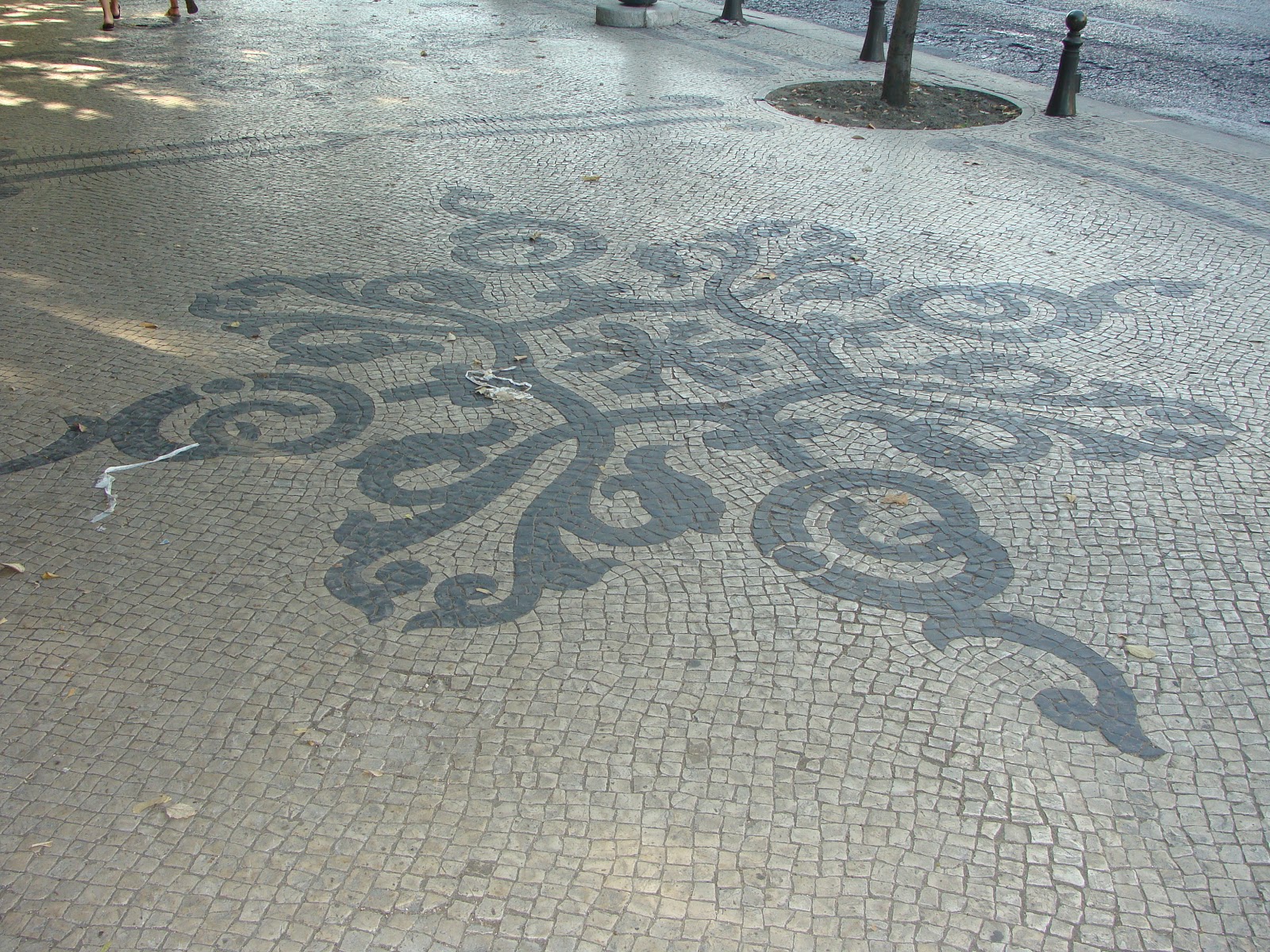
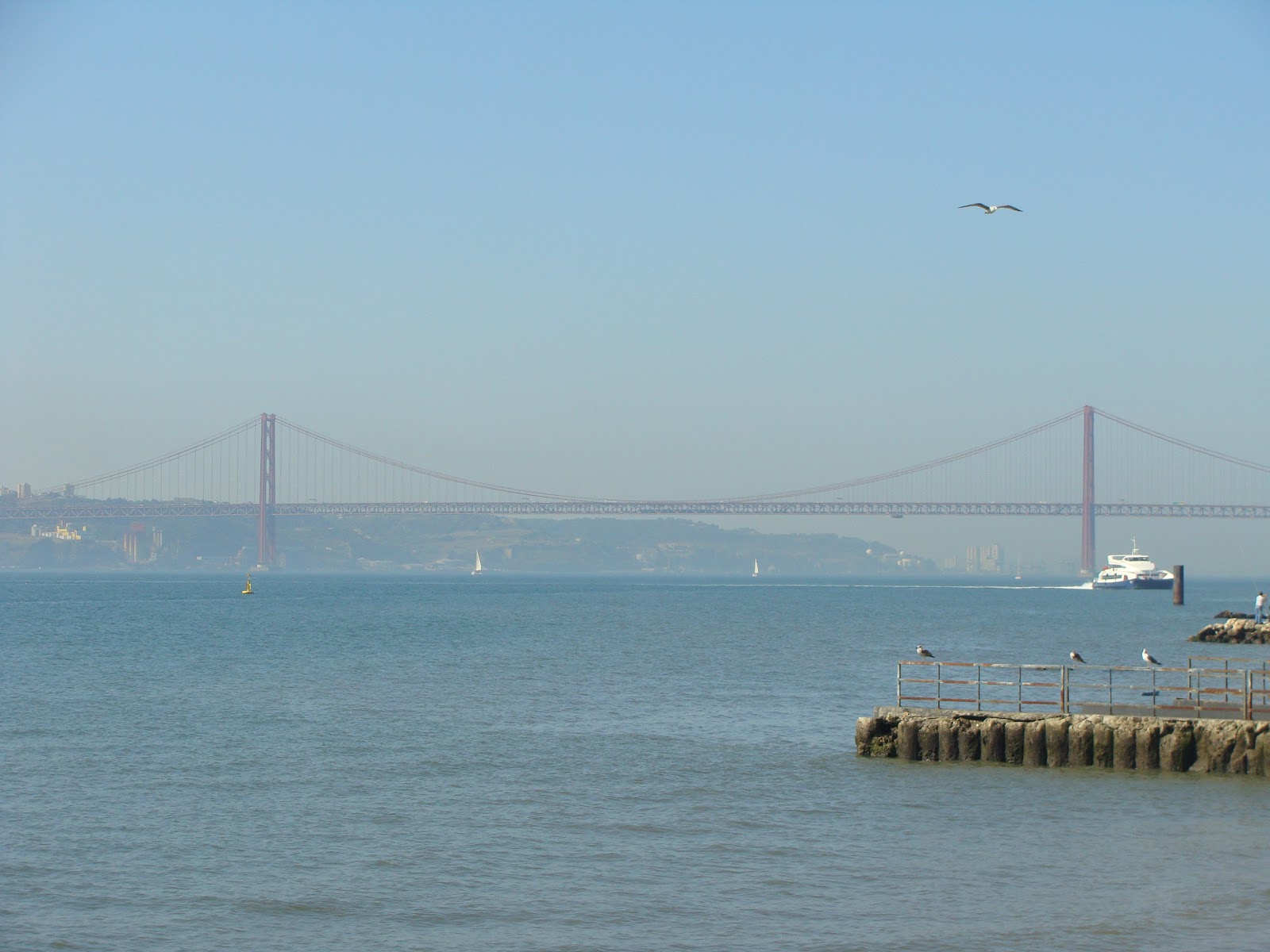
                We arrived to Portugal at 9am on Wednesday. Leah and her mom picked us up from the airport, and, wasting no time, Leah took us on a greatest hits tour of Lisboa, as it’s called in Portuguese. We walked all over the city, with Leah as our fabulous tour guide, and enjoyed the cultural sites. Lisbon was beautiful and relatively uncrowded. Buildings - inside and out - were decorated with ornate Portuguese tile, and I loved the colorful effect they gave the architecture. The streets and sidewalks were commonly paved with small cube stones that were like organized cobblestones. They created beautiful designs, but were also crazy slippery and, as Milagros told us, horrible in both rain and high heels. We walked down one of the main boulevards to a plaza downtown to try traditional cherry liqueur, and Leah promptly had us tipsy at 10:30am. We walked off the buzz and later ate some traditional Portuguese food. Jess had duck with rice, and I enjoyed bacalao a bras - cod with potatoes sautéed in eggs. Bacalao (cod) is common in Portugal and Leah told me about a saying that ‘there are a thousand ways to cook bacalao in portugal’. Our tour continued and we saw all the main monuments - from the Santa Justa Elevator, which was designed to connect the highest and lowest parts of Lisbon, to the castle of Sao Jorge, set high above the city with beautiful views of the bay and river, to the 25 of Abril bridge which looked surprising like the Golden Gate. Having traversed the city, we went home exhausted and fell right asleep after a lovely dinner with Leah’s family.

The slippy "cobblestones" lining the sidewalk

The Golden Gate Bridge???? nah, Its the 25 of April Bridge.

Sample 1 of tiling on the outside of a building

Tiling from a distance

Sample 2 of tiling on the outside of a building

Tiling from a distance.

View from within the Santa Justa Elevator

View from on top of the Santa Justa Elevator

Leah and Jess about to enjoy lunch

The view from St. George Castle

The rooster portrayed in a quilt - it's a traditional Portuguese symbol representing luck, faith and justice.

Tiles decorating the inside of a building


                The next day had more sightseeing - the Museum, the Tower of Belen, the Oceanarium - all lovely. And - one of my favorite parts of the day - our stop at Starbucks. Yesssss … STARBUCKS. I'm ashamed to admit it, but I’m missing Starbucks. There aren't any in Bilbao, and no coffee equivalent really exists. But, what’s worse for me is that there isn't really a cafe culture in Bilbao. At home, cafes are one of my leading school survival mechanisms and I love to curl up with my books or my computer, sometimes good company, and a cup of coffee. I can pass hours in cafes at home, and it is something I honestly miss in Bilbao. So, in Belen on Thursday we stood in the line to purchase the famous Belen pasteis which are custard like cakes with a delicious crispy layered shell. We then brought them next door to Starbucks, ordered a latte and sat using the wifi for awhile. I have to admit, there was something soothing about its familiarity and it, too, helped scratch the itch that is homesickness.


Me with the Oceanarium mascot dude.

Leah and Jess waiting in line to buy Belem cakes.

yay starbucks!!

The Tower of Belen


                Our final day in Portugal, we traveled to the town of Sintra which was the country home of the Portuguese royalty and had beautiful mansions, forests, castles and gardens. We wandered around the small, touristy town, and admired its beauty. I was constantly amused by the apparent tendency of the Portuguese to overestimate time. For example, we were told that the Quinta da Regaleira would be a 10 minute walk from the bus stop; 5 minutes off the bus we were there. Later, we were told the Palacio da Pena was a 10 minute walk up a hill; in 3 minutes we were up the entire hill. A man told us it was a 15 minute walk to the train station; it took 10. Earlier in the week, Leah told us it would take 40 minutes on the metro to get to the Oceanarium; it took 20. Perhaps the Portuguese allow extra time for tourist behavior, or perhaps they are experts at strolling. Regardless, I found the consistent quirk amusing. And, truthfully, discovering the little quirks of various cultures is partially what I love about traveling. Of course, I can't presume that everything I notice is a cultural difference - most of the places I visit I don't spend enough time in to know if it is cultural or simply serendipitous. But, nonetheless, it's the differences that make me smile - both at my experiences and at the place I'm in.

Gardens and secret caves at the Quinta

A "Wishing Well" at the Quinta that you could climb down and walk through the tunnels of the gardens.

The mansion at the Quinta.

The colorful Palacio da Pena

Me at the Palacio da Pena, on the wall walk ... it was windy.

Sunday, October 2, 2011

Who needs fiesta when you have siesta? - Saturday, October 1, 2011


                This week we continued our studies of EU structure, Regulation 44, and the area of freedom, security and justice. I’m finally hitting my stride, and life seems to have a familiar pattern, which I’m realizing I appreciate more than I knew. Our class schedule has no consistency; day to day and week to week it varies. We sometimes have class four days a week, sometimes one. Lecturers rotate, teaching one to three classes at a time. Some days we have class starting at 8am, sometimes it starts at 1pm, sometimes its 6pm. The one single consistency is that each day we have time for a long lunch and a siesta. I had thought the Spanish siesta was a stereotype – something like American’s love of soda and McDonalds – but it’s actually still a prominent part of the culture, at least here in Bilbao. From around 2:00pm to 4:00pm, most shops close and the streets become quieter. I personally avoid napping during this time for fear my night time schedule will be confused, but inevitably I feel a bit lethargic, as if the siesta penetrates the air itself. I appreciate the relaxation break in the middle of the day, but it’s a huge culture clash for Americans as our initial reaction is: What do you mean I can’t purchase things whenever I want or need throughout the day? and Don’t businesses lose money during those two hours? But, it’s clear that the priority here is to relax and enjoy life – something that’s exemplified through many facets of Spanish culture. My roommate, Nerea, often comes home during siesta, to eat lunch and relax for a bit. Lunch is the biggest daily meal here, and at restaurants you can usually only order the “Menu del dia”. It’s a semi-fixed menu which includes a first course, second course, desert, wine and bread. Every time I partake in the menu del dia, I tell myself not to do it again – it’s just too much food for me to eat at one time, even if I don’t eat the rest of the day. Spaniards eat out much less than Americans do, which explains why they can remain so fit despite these elaborate meals. But, enjoying the menu del dia is definitely a cultural experience, so today Jessica and I partook. We both had heavy salads as the first course, and Jess had steak as the second course. For my second course, I ate the traditional ‘squid in its own ink’ which consists of about 4 pieces of calamari steak, drowning in the blackest sauce you’ve ever seen. There’s no strong flavor, but the sauce has a uniquely rich texture. I can’t say it’s the best thing I’ve ever eaten, but it is a common local dish, and relatively enjoyable. We shared a bottle of wine, and of course ate bread, which is always fresh and delicious here. For dessert, Jess had flan and I had rice pudding – both common desserts. Needless to say, that day we went home and completed our cultural immersion by celebrating the siesta.   

sooooo muchhhhh fooooooooodddd....

that dessert was torture. But already paid for, so we ate it anyways.